The federal government has moved to provide major electricity tariff relief to industrial consumers by shifting a significant portion of power system costs onto domestic users, sparking fresh concerns over rising household utility bills.
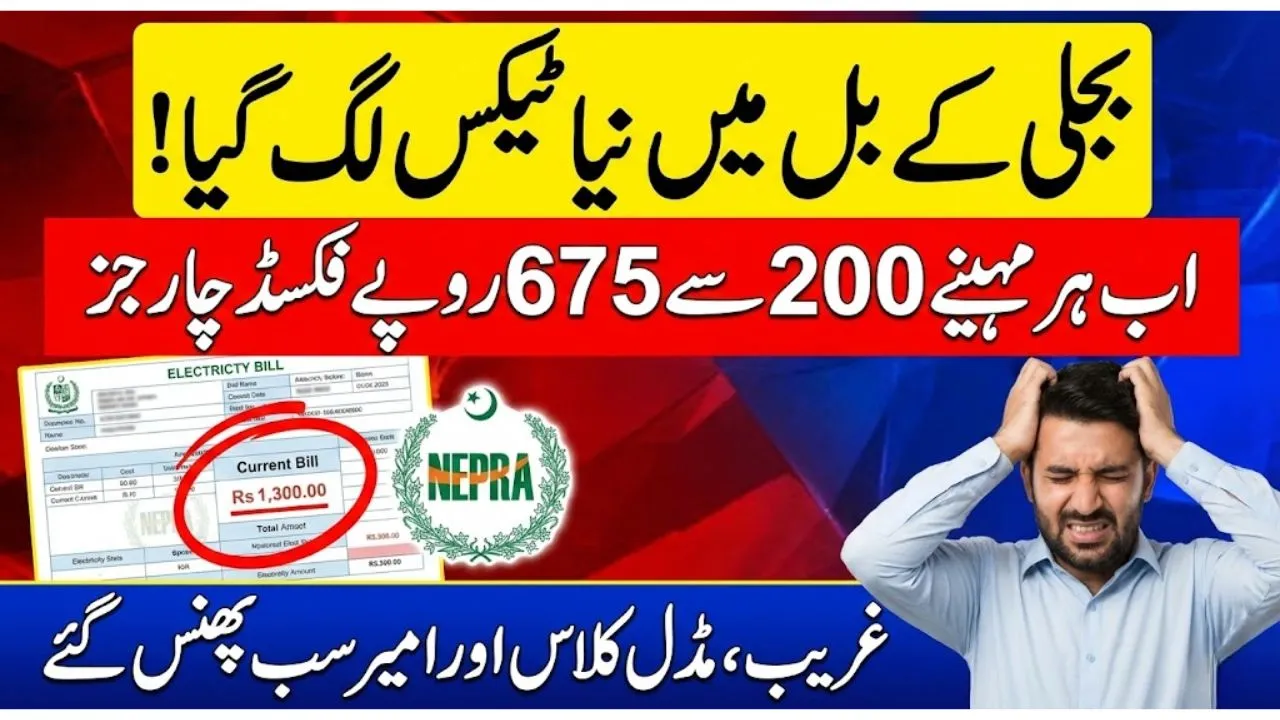
Under a newly proposed plan, the government intends to impose monthly fixed charges ranging from Rs. 200 to Rs. 675 on more than 28.5 million residential electricity consumers. The move is aimed at raising approximately Rs. 125 billion to finance a Rs. 4.04 per unit tariff relief package for industrial users.

Tariff Proposal Submitted to Nepra
The revised Schedule of Tariff (SoT) was submitted to National Electric Power Regulatory Authority on Friday evening and was immediately placed on notice for a public hearing, expected to be held on the first available working day after the weekend. The government wants the new tariff structure implemented within the current month.
According to officials, the proposal received formal approval from the Federal Cabinet on February 4.

Who Is Exempt and Who Will Pay
The fixed charge will apply to nearly all residential consumers, except lifeline users consuming less than 100 units per month.
 WhatsApp Channel
Key slabs include:
- Rs. 200 fixed charge for about 9.9 million consumers using under 100 units per month
- Rs. 300 fixed charge for 6.1 million protected consumers using up to 200 units
- Consumers must stay within these limits for six consecutive months to qualify for average unit prices of Rs. 10.54 and Rs. 13, respectively
Non-protected consumers who exceed the 100-unit limit even once in six months will face a fixed Rs. 275 charge, affecting around 5.7 million users, with per-unit costs exceeding Rs. 22.44, excluding taxes.
Higher consumption slabs will face steeper fixed charges:
- Rs. 300 for up to 200 units (2.24 million consumers)
- Rs. 350 for 201–300 units (2.9 million consumers)
- Rs. 400 for 301–400 units (around 1 million consumers)
- Rs. 500 for 401–500 units (about 400,000 consumers)
- Rs. 675 for usage above 500 units (around 410,000 consumers)

Revenue Targets and IMF Commitments
The Power Division told Nepra that the fixed charge would generate around Rs. 106 billion in tariff revenue and an additional Rs. 19 billion in sales tax.
Officials said this restructuring will reduce cross-subsidy pressures on industrial consumers, allowing a Rs. 4.04 per unit tariff cut without breaching subsidy limits agreed with the International Monetary Fund.
The government has committed to keeping total power subsidies within Rs. 249 billion.

Why the Government Is Making This Shift
According to the Power Division, the fixed charge reflects the rising fixed costs of the power system, especially as more consumers shift toward off-grid solar solutions, reducing unit-based electricity consumption.
Officials argued that the existing tariff framework relies heavily on volumetric recovery, which no longer aligns with a system where most costs are fixed rather than variable.
“There is a structural misalignment between revenue requirements and the current recovery mechanism,” the division stated, adding that the existing setup places a disproportionate burden on certain consumers and accelerates migration away from the national grid.

Public Reaction Likely Ahead
While the government says the new structure ensures long-term financial sustainability of the power sector, the move is expected to trigger debate, particularly among middle- and lower-income households already struggling with inflation and rising living costs.
The upcoming Nepra public hearing is likely to attract strong public response as millions of domestic consumers brace for higher fixed electricity charges in the coming months.